How to Get Promoted to Executive in 2026
For years, this leader was stuck.
Not stuck in a bad job. Not stuck without options. But stuck in the invisible space between where they were and where they wanted to be.
As a Director of Design at a global tech company (a market leader servicing Fortune 500 clients across Europe and North America), this leader was successful by all accounts. But success wasn't the problem.
The problem was growth had stalled.
The Ambition Trap
"I'm an ambitious person," they told me during our first conversation. "One of my personal mantras is: I want to be better than I was yesterday. But I wasn't achieving that anymore."
They had hit what many high-performers hit: the strategy ceiling.
What got them to director-level (hard work, individual contribution, pushing boulders uphill alone) wasn't going to get them to the executive level. They knew it. But they didn't know what to do about it.
"I was struggling with managing up," they explained. "I didn't know how to do that in the context of who I wanted to be, where I wanted to go, and where the company wanted to go."
There was friction. Between their goals and the company's direction. Between their ambitions and their current reality. And most frustratingly, they couldn't articulate what the friction was.
They'd been feeling this way for a couple of years.
What Got You Here Won't Get You There
The insight that changed everything wasn't complicated. But it was profound:
What got you here may not get you to where you're trying to go.
This leader had climbed to director-level by working harder than everyone else. By being the one who delivered. By using sheer momentum and individual excellence.
But the executive level required different strategies:
- Delegation, not just execution
- Influence, not just output
- Intentionality, not just effort
- Managing up, not just managing down
They needed to stop doing the work and start leading the work.
The Turning Point: The Executive Dashboard
The breakthrough came through a simple exercise: mapping personal goals to company goals.
"You had this worksheet," they recalled. "Two columns. What my personal goals were. What the company's goals were. And it was so insightful."
As a Director of Design, they were always advocating for the user. But advocacy without alignment is just noise.
"Sometimes you can advocate and be on a soapbox and no one's listening," they said. "Or you can advocate in a way the company will actually hear you."
We broke down their role and responsibilities. Then we mapped each one to the company's goals, vision, and execution strategy.
Suddenly, everything clicked.
Their ambitions and the company's direction weren't in conflict. They just weren't framed in a way that made the connection clear.
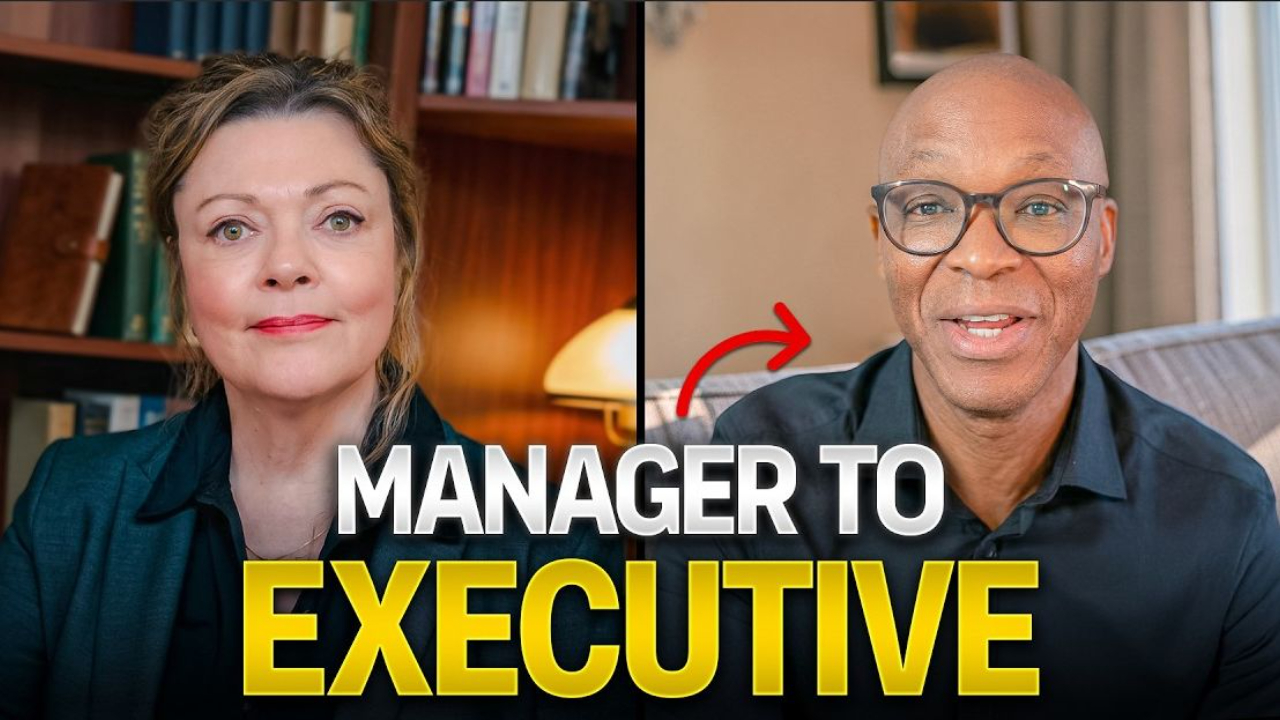
The Mind Shift: From Manager to Executive
Before coaching, this leader couldn't connect the dots. They felt frustrated. Stuck. Like they were spinning their wheels.
"I couldn't influence projects I felt were important," they said. "I was managing a high-performing team, but I wanted to give more, and I couldn't."
That's the manager trap: getting it from the top and from below, with nothing left to give.
After coaching, everything changed. Not because they worked harder. But because they worked intentionally.
What Changed:
1. Intentional Meetings Every meeting had a purpose. Every conversation was designed to create value (not just for them, but for the organization).
2. Intentional Communication They stopped just talking to their team. They started asking: How is this conversation going to drive value for the overall organization?
3. Intentional Documentation They stopped writing for themselves. Every email, every note, every piece of documentation was created with value in mind: How can this information become valuable to my team or my leadership?
4. Business Case Thinking They started tracking metrics. Showing impact. Building a case for their ideas (not a legal argument, but a business case).
"Everything has intentionality in terms of value and impact," they said.
The Promotion (And What It Really Meant)
It took about a year and a half. But they got the promotion to executive.
More importantly, they got clarity.
They stopped feeling frustrated. They started influencing the projects that mattered. They became the leader they wanted to be.
"It's not just changing your career," they said. "It's changing your life. The tools and tactics I learned? I'm using them with my family, my neighbors, everywhere."
They paused. "When I interact with people now, I think about impact and value. Are they influencing me? How are they influencing me? Am I impacting them?"
The Real Value
When I asked them to put a dollar value on the coaching, they hesitated.
"You can't really put a dollar value on it. But if you held my feet to the fire? I'd equate it to an executive salary, executive impact, executive influence."
They went on: "It's empowering. It's enlightening. And you can't put a value on that because it's not just about the promotion. It's about becoming the person who deserves the promotion."
The Lesson
Most people aren't stuck because they lack talent.
They're stuck because they're using manager strategies at an executive level.
The shift isn't about working harder. It's about:
- Aligning your goals with the organization's vision
- Framing your value in terms the company understands
- Influencing instead of just executing
- Leading instead of just doing
If you've been stuck for a year (or two), ask yourself:
Am I still using the strategies that got me here to try to get me there?
Because what got you here won't get you there.
But with the right strategies, clarity, and intentionality?
You'll get there faster than you think.
Ready to make the shift from manager to executive? Let's talk.